 The latest news
- Due nuove consegne di latte in polvere June 17, 2026
- Gaza: Paola Manduca ci ha lasciati ma Milky Way prova a resistere grazie a New Weapons Research Group May 17, 2025
- Appello urgente: la politica genocida di Israele per distruggere gli ospedali nel nord di Gaza procede senza controllo nel mezzo dell’inazione internazionale October 23, 2024
- Joe Biden reclamato dai medici USA September 16, 2024
- Untitled September 9, 2024
- Fondo dei piccoli per Gaza September 9, 2024
- la via del latte. stoccaggio in Giordania September 9, 2024
- consegna latte September 9, 2024
- la via del latte -milk way September 9, 2024
- la via del latte per i bambini di Gaza September 1, 2024
VIDEO ABOUT 2021 war
Posted in War
Comments Off on VIDEO ABOUT 2021 war
A 70-year-old man in Gaza needed open heart surgery. It was a race against time | 90.5 WESA
Posted in Blockade
Comments Off on A 70-year-old man in Gaza needed open heart surgery. It was a race against time | 90.5 WESA
An open letter for the people in Gaza
July 8th, 2014 the war on Gaza began arbitrarily, of extreme violence on all the people, and 55 days long. It brought losses in lives, in livelihood and a disaster long lasting.
July 8th, 2022 the El Adha festivities begin and we wish these bring serenity to the Gaza people with the hope they soon regain freedom from the blockade and that the young people can design the life they desire, the older continue it in peace and good health.
Published Online
July 22, 2014
http://dx.doi.org/10.1016/
S0140-6736(14)61044-8
See World Report page 389
July 22, 2014
http://dx.doi.org/10.1016/
S0140-6736(14)61044-8
See World Report page 389
We are doctors and scientists, who
spend our lives developing means to
care and protect health and lives. We
are also informed people; we teach
the ethics of our professions, together
with the knowledge and practice of it.
We all have worked in and known the
situation of Gaza for years.
On the basis of our ethics and
practice, we are denouncing what we
witness in the aggression of Gaza by
Israel.
We ask our colleagues, old and
young professionals, to denounce
this Israeli aggression. We challenge
the perversity of a propaganda that
justifi es the creation of an emergency
to masquerade a massacre, a so-called
“defensive aggression”. In reality it is a
ruthless assault of unlimited duration,
extent, and intensity. We wish to report
the facts as we see them and their
implications on the lives of the people.
We are appalled by the military
onslaught on civilians in Gaza under
the guise of punishing terrorists. This is
the third large scale military assault on
Gaza since 2008. Each time the death
toll is borne mainly by innocent people
in Gaza, especially women and children
under the unacceptable pretext of
Israel eradicating political parties and
resistance to the occupation and siege
they impose.
This action also terrifi es those who
are not directly hit, and wounds the
soul, mind, and resilience of the young
generation. Our condemnation and
disgust are further compounded by
the denial and prohibition for Gaza to
receive external help and supplies to
alleviate the dire circumstances.
The blockade on Gaza has
tightened further since last year
and this has worsened the toll on
Gaza’s population. In Gaza, people
suff er from hunger, thirst, pollution,
shortage of medicines, electricity,
and any means to get an income, not
only by being bombed and shelled.
Power crisis, gasoline shortage, water
and food scarcity, sewage outflow
and ever decreasing resources
are disasters caused directly and
indirectly by the siege.1
People in Gaza are resisting this
aggression because they want a
better and normal life and, even
while crying in sorrow, pain, and
terror, they reject a temporary truce
that does not provide a real chance
for a better future. A voice under
the attacks in Gaza is that of Um Al
Ramlawi who speaks for all in Gaza:
“They are killing us all anyway—
either a slow death by the siege, or a
fast one by military attacks. We have
nothing left to lose—we must fi ght
for our rights, or die trying.”2
Gaza has been blockaded by sea and
land since 2006. Any individual of
Gaza, including fi shermen venturing
beyond 3 nautical miles of the coast
of Gaza, face being shot by the Israeli
Navy. No one from Gaza can leave
from the only two checkpoints, Erez
or Rafah, without special permission
from the Israelis and the Egyptians,
which is hard to come by for many,
if not impossible. People in Gaza are
unable to go abroad to study, work,
visit families, or do business. Wounded
and sick people cannot leave easily
to get specialised treatment outside
Gaza. Entries of food and medicines
into Gaza have been restricted and
many essential items for survival are
prohibited.3
Before the present assault,
medical stock items in Gaza were
already at an all time low because of
the blockade.3
They have run out now.
Likewise, Gaza is unable to export its
produce. Agriculture has been severely
impaired by the imposition of a buff er
zone, and agricultural products cannot
be exported due to the blockade. 80%
of Gaza’s population is dependent on
food rations from the UN.
Much of Gaza’s buildings and
infrastructure had been destroyed
during Operation Cast Lead, 2008–09,
and building materials have been
blockaded so that schools, homes, and
institutions cannot be properly rebuilt.
Factories destroyed by bombardment
have rarely been rebuilt adding
unemployment to destitution.
Despite the difficult conditions,
the people of Gaza and their political
leaders have recently moved to
resolve their confl icts “without arms
and harm” through the process of
reconciliation between factions,
their leadership renouncing titles and
positions, so that a unity government
can be formed abolishing the divisive
factional politics operating since
2007. This reconciliation, although
accepted by many in the international
community, was rejected by Israel.
The present Israeli attacks stop this
chance of political unity between
Gaza and the West Bank and single
out a part of the Palestinian society
by destroying the lives of people
of Gaza. Under the pretext of
eliminating terrorism, Israel is trying
to destroy the growing Palestinian
unity. Among other lies, it is stated
that civilians in Gaza are hostages of
Hamas whereas the truth is that the
Gaza Strip is sealed by the Israelis and
Egyptians.
Gaza has been bombed con-
tinuously for the past 14 days
followed now by invasion on land
by tanks and thousands of Israeli
troops. More than 60 000 civilians
from Northern Gaza were ordered to
leave their homes. These internally
displaced people have nowhere to
go since Central and Southern Gaza
are also subjected to heavy artillery
bombardment. The whole of Gaza is
under attack. The only shelters in Gaza
are the schools of the UN Relief and
Works Agency for Palestine Refugees
in the Near East (UNRWA), uncertain
shelters already targeted during Cast
Lead, killing many.
According to Gaza Ministry of Health
and UN Office for the Coordination
of Humanitarian Affairs (OCHA),1
as of July 21, 149 of the 558 killed in
Gaza and 1100 of the 3504 wounded
are children. Those buried under
the rubble are not counted yet. As
we write, the BBC reports of the
bombing of another hospital, hitting
the intensive care unit and operating
theatres, with deaths of patients and
staff . There are now fears for the main
hospital Al Shifa. Moreover, most
people are psychologically traumatised
in Gaza. Anyone older than 6 years
has already lived through their third
military assault by Israel.
The massacre in Gaza spares no
one, and includes the disabled and
sick in hospitals, children playing on
the beach or on the roof top, with a
large majority of non-combatants.
Hospitals, clinics, ambulances,
mosques, schools, and press
buildings have all been attacked,
with thousands of private homes
bombed, clearly directing fi re to target
whole families killing them within
their homes, depriving families of
their homes by chasing them out
a few minutes before destruction.
An entire area was destroyed on
July 20, leaving thousands of displaced
people homeless, beside wounding
hundreds and killing at least 70—
this is way beyond the purpose of
finding tunnels. None of these are
military objectives. These attacks aim
to terrorise, wound the soul and the
body of the people, and make their
life impossible in the future, as well
as also demolishing their homes and
prohibiting the means to rebuild.
Weaponry known to cause long-
term damages on health of the whole
population are used; particularly non
fragmentation weaponry and hard-
head bombs.4,5 We witnessed targeted
weaponry used indiscriminately and
on children and we constantly see that
so-called intelligent weapons fail to
be precise, unless they are deliberately
used to destroy innocent lives.
We denounce the myth propagated
by Israel that the aggression is done
caring about saving civilian lives and
children’s wellbeing.
Israel’s behaviour has insulted our
humanity, intelligence, and dignity
as well as our professional ethics and
eff orts. Even those of us who want to
go and help are unable to reach Gaza
due to the blockade.
This “defensive aggression” of
unlimited duration, extent, and
intensity must be stopped.
Additionally, should the use of
gas be further confirmed, this is
unequivocally a war crime for which,
before anything else, high sanctions
will have to be taken immediately on
Israel with cessation of any trade and
collaborative agreements with Europe.
As we write, other massacres and
threats to the medical personnel in
emergency services and denial of
entry for international humanitarian
convoys are reported.6
We as
scientists and doctors cannot keep
silent while this crime against
humanity continues. We urge
readers not to be silent too. Gaza
trapped under siege, is being killed
by one of the world’s largest and
most sophisticated modern military
machines. The land is poisoned by
weapon debris, with consequences
for future generations. If those of
us capable of speaking up fail to do
so and take a stand against this war
crime, we are also complicit in the
destruction of the lives and homes of
1·8 million people in Gaza.
We register with dismay that only
5% of our Israeli academic colleagues
signed an appeal to their government
to stop the military operation against
Gaza. We are tempted to conclude that
with the exception of this 5%, the rest of
the Israeli academics are complicit in the
massacre and destruction of Gaza. We
also see the complicity of our countries
in Europe and North America in this
massacre and the impotence once
again of the international institutions
and organisations to stop this massacre.
We declare no competing interests.
*Paola Manduca, Iain Chalmers,
Derek Summerfi eld, Mads Gilbert,
Swee Ang, on behalf of 24 signatories
paolamanduca@gmail.com
New Weapons Research Group and University of
Genoa, Genoa, Italy (PM); James Lind Library,
Oxford, UK (IC); Institute of Psychiatry, King’s
College,London, UK (DS); Clinic of Emergency
Medicine, University Hospital of North Norway,
Tromso, Norway (MG); and Barts and the Royal
London Hospital, London, UK (SA).
1 United Nations Offi ce for the Coordination of
Humanitarian Aff airs (OCHA). Occupied
Palestinian Territory: Gaza emergency
situation report (as of 21 July 2014, 1500 hrs).
http://www.ochaopt.org/documents/ocha_
opt_sitrep_22_07_2014.pdf (accessed
July 22, 2014).
2 Webb-Pullman J. Dignity or death—we cannot
give up now. http://gaza.scoop.ps/2014/07/
dignity-or-death-we-cannot-give-up-now/
(accessed July 22, 2014).
3 Gilbert M. Brief report to UNRWA: The Gaza
Health Sector as of June 2014. http://www.
unrwa.org/sites/default/fi les/fi nal_report_-_
gaza_health_sector_june-july_2014_-_mads_
gilbert_2.pdf (accessed July 22, 2014).
4 Naim A, Al Dalies H, El Balawi M, et al. Birth
defects in Gaza: prevalence, types, familiarity
and correlation with environmental factors.
Int J Environ Res Public Health 2012; 9: 1732–47.
5 Manduca P, Naim A, Signoriello S. Specifi c
association of teratogen and toxicant metals in
hair of newborns with congenital birth defects
or developmentally premature birth in a cohort
of couples with documented parental exposure
to military attacks: observational study at
Al Shifa Hospital, Gaza, Palestine.
Int J Environ Res Public Health 2014; 11: 5208–23.
6 Ma’an News Agency. 4 killed, over 50 injured
as Israel targets al-Aqsa hospital. http://www.
maannews.net/eng/ViewDetails.
aspx?ID=715087 (accessed July 22, 2014).
Posted in Blockade
Comments Off on An open letter for the people in Gaza
Israel Medical Association aiding torture of a Palestinians, rights group says – Middle East Monitor
https://www.middleeastmonitor.com/20220706-israel-medical-association-aiding-torture-of-a-palestinians-rights-group-says/
Posted in Blockade
Comments Off on Israel Medical Association aiding torture of a Palestinians, rights group says – Middle East Monitor
Recording available for An Invisible Crisis: Mental health care in the shadow of Israel’s 15-year closure of Gaza
An Invisible Crisis: Mental health care in the shadow of Israel’s 15-year closure of Gaza.
A recording of the event is available here: https://www.youtube.com/
In late 2021, Gisha and the Gaza Community Mental Health Programme (GCMHP) convened a group of mental health professionals working in the Strip to discuss the effects of Israel’s closure on mental health, as well as the challenges therapists and care specialists face as residents living under closure in Gaza themselves.
The speakers: Tania Hary – Executive Director, Gisha
Mohammad Azaiza – Gaza Field Coordinator, Gisha
Dr. Yasser Abu Jamei – General Director, GCMHP
Rawia Hamam – Director of Training and Research, GCMHP
Posted in Blockade
Comments Off on Recording available for An Invisible Crisis: Mental health care in the shadow of Israel’s 15-year closure of Gaza
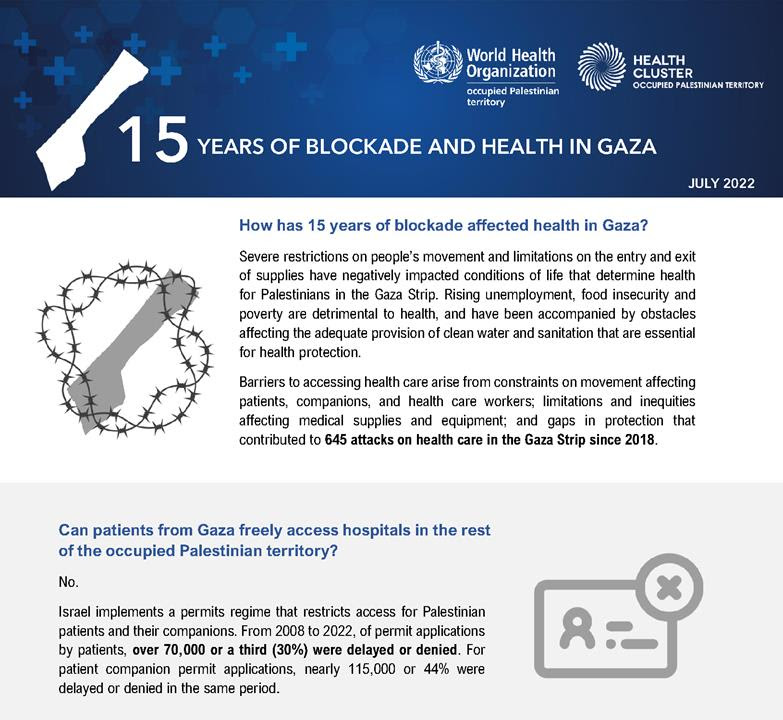
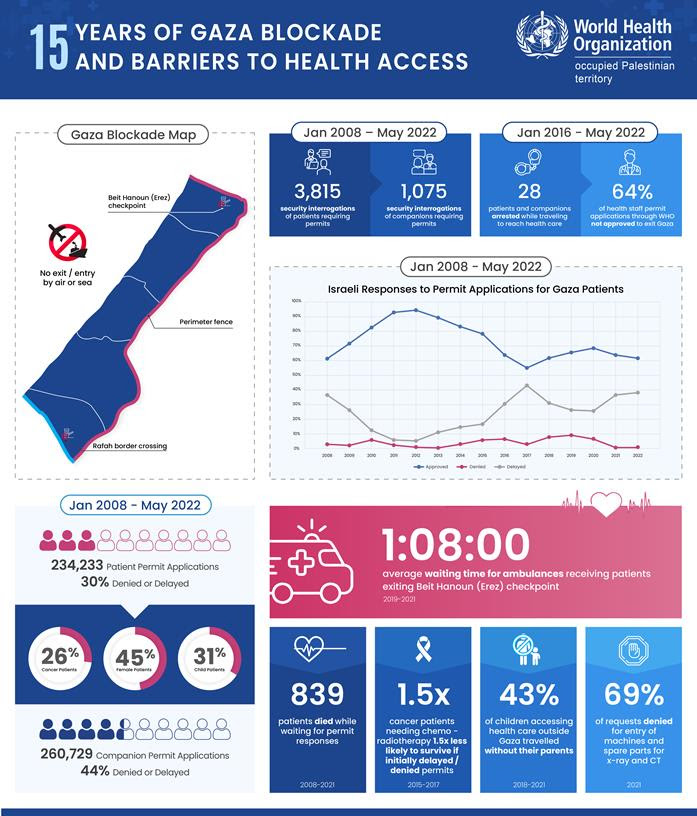
15 YEARS OF BLOCKADE AND HEALTH IN GAZA
Posted in Blockade
Comments Off on 15 YEARS OF BLOCKADE AND HEALTH IN GAZA
Al Mezan holds Israel responsible for the death of Gaza patient Jihad al-Qedra after being denied nine appointments at West Bank hospitals
Al Mezan strongly condemns the discriminatory movement restrictions imposed by Israeli authorities on Palestinian patients from the Gaza Strip. Israel’s arbitrary and draconian permit system delays or denies patients access to hospitals outside Gaza in around 30 percent of urgent cases. The most recent case of delay lead to the death of Jihad al-Qedra, a 55-years-old cancer patient from Gaza, who died after he was denied access to medical care at a hospital outside Gaza by Israeli authorities at the Erez Crossing.
According to Al Mezan, al-Qedra’s legal representative, he suffered from Nasopharyngeal cancer for years. Despite having obtained a medical referral from the Palestinian Ministry of Health and secured appointments at the Augusta Victoria Hospital in Jerusalem and Patients Friends Society Al-Rahma Hospital in Nablus, Israeli authorities denied him the requisite exit permit to travel for nine different appointments, the last of which scheduled for 22 June 2022 in Nablus. This delay led to a serious deterioration of al-Qedra’s health condition and eventually to his death on Monday 4 July 2022.
Since the beginning of 2022, Al Mezan intervened as the legal representative for more than 440 patients in Gaza and succeeded to facilitate the access of 154 patients to hospitals outside the Gaza Strip. Al Mezan’s decades of experience in representing patients with legal interventions indicates that Israel’s denials or delays of permits are not based on any valid reasons, but rather are part of the collective punishment and apartheid regime to which it subjects more than two million Palestinians in the Gaza Strip. Notably, al-Qedra is the third patient to die since the beginning of 2022 due to Israeli delay or denial of medical permits.
Al Mezan deeply regrets the death of the cancer patient Jihad al-Qedra and holds Israel fully responsible for his death. As the occupying power, Israel must adhere to the provisions of the Fourth Geneva Convention of 1949 as well as international human rights law, which protect the rights to life, freedom of movement, and to physical and mental health.
Al Mezan calls on the international community—in particular, the High Contracting Parties to the 1949 Geneva Conventions—to uphold their moral and legal obligations vis-à-vis the protected Palestinian people and to ensure Israel complies with its obligations under international law, ends the closure and blockade on the Gaza Strip, and stops its ongoing restrictions of Palestinian patients’ access to medical care outside the Gaza Strip. Lastly, Al Mezan reiterates that the continued impunity provided to the Israeli forces encourages the repetition of crimes and violations against the Palestinian people.
To read the press release, please click here
and on Twitter here
Posted in Blockade
Comments Off on Al Mezan holds Israel responsible for the death of Gaza patient Jihad al-Qedra after being denied nine appointments at West Bank hospitals
GAZA STRIP THE HUMANITARIAN IMPACT OF 15 YEARS OF THE BLOCKADE
In June 2007, following the military takeover of Gaza by Hamas, the
Israeli authorities significantly intensified existing movement restrictions,
virtually isolating the Gaza Strip from the rest of the occupied Palestinian
territory (oPt), and the world. This land, sea and air blockade has
significantly exacerbated previous restrictions, limiting the number and
specified categories of people and goods allowed in and out through the
Israeli-controlled crossings.
l Prior to the Second Intifada in 2000, up to half a million exits of people
from Gaza into Israel, primarily workers, were recorded in a single month.
For the first seven years of the blockade, this number declined to just over
4,000 on average, rising to 10,400 monthly over the next eight years.
l So far in 2022, the Israeli authorities have approved only 64% of patients’
requests to exit Gaza mainly for specialized treatment in the West
Bank, including East Jerusalem, by the time of the scheduled medical
appointment. In previous years, patients have died while awaiting a
response to their application.
The Egyptian authorities closed the Rafah border crossing with Gaza for
long periods after 2014 following political unrest in Egypt. Rafah has been
mostly operational since mid-2018, and was open for 95 days out of 151 in
the first five months of 2022.
After the blockade, the number of truckloads of commercial goods exiting
Gaza dropped significantly to only two truckloads on average per month in
2009. Following the 2014 escalation of hostilities, commercial transfers
from Gaza to the West Bank resumed, and from March 2015 exports to
Israel also resumed. In August 2021, exports to Egypt started for the
first time, boosting the monthly average of exports to 787 in the first five
months of 2022. Pre-blockade, the average monthly high was 961.
The volume of truckloads entering Gaza in the first five months of 2022,
around 8,000 per month, was about 30% below the monthly average for
the first half of 2007, before the blockade. Since then, the population has
grown by more than 50%.
Israeli forces have largely restricted access to areas within 300 metres
of the Gaza side of the perimeter fence with Israel; areas several hundred
metres beyond are deemed not safe, preventing, or discouraging,
agricultural activities.
Israeli forces restrict access off the Gaza coast, currently only allowing
fishermen to access 50% of the fishing waters allocated for this purpose
under the Oslo Accords.
Unemployment levels in Gaza are amongst the highest in the world: the
Q1 jobless rate in 2022 was 46.6%, compared with an average of 34.8%
in 2006. Youth unemployment for the same period (age 15-29) stands at
62.5%. (PCBS)
31% of households in Gaza have difficulties meeting essential education
needs such as tuition fees and books, due to lack of financial resources.
1.3 million out of 2.1 million Palestinians in Gaza (62%) require food
assistance.
At its current operating capacity, the Gaza Power Plant can only produce up
to 80 megawatts (MW), supplemented by 120 MW purchased from Israel,
meeting about 50% of the electricity demand in Gaza (400-450MW). In
2021, rolling power cuts averaged 11 hours per day.
78% of piped water in Gaza is unfit for human consumption.
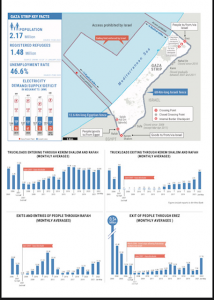
1. About 2.1 million Palestinians in Gaza are ‘locked in’, the vast
majority unable to access the remainder of the oPt and the
outside world, limiting access to medical treatment unavailable
in Gaza, to higher education, to family and social life, and to
employment and economic opportunities. Movement restrictions
imposed by the Israeli authorities since the early 1990s and which
were intensified after the Hamas takeover of June 2007, citing
security justifications, have had a profound impact on living
conditions in Gaza and have fragmented the territorial unity and
the economic and social fabric of the oPt. Those eligible for
exit permits constitute a small minority, primarily day labourers,
businesspeople, medical patients and staff of international
organizations. While the isolation of Gaza has been eased to some
degree by Egypt’s reopening of the Rafah crossing since 2018,
movement through Rafah remains restricted and the selection
criteria for travelers uncertain.
2. Longstanding access restrictions imposed by the Israeli
authorities have undermined Gaza’s economy, resulting in high
unemployment, food insecurity and aid dependency. These
include restrictions on the marketing of goods in the West Bank
and Israel; on the entry of certain goods to Gaza; and on the access
of people to agricultural land and fishing waters in Gaza itself. The
impact of access restrictions is compounded by recurrent rounds
of hostilities, which have resulted in the loss of assets and people
being left with long-term disabilities; by a chronic energy crisis;
and by the ongoing internal Palestinian divide. In August 2021, the Israeli authorities expanded the number of items permitted into
Gaza, lifting broad restrictions introduced during the May 2021
escalation.
3. Restrictions on the entry of goods considered by the Israeli
authorities as ’dual-use’ items, imposed citing security concerns,
continue to undermine the quality of basic services and impede
efforts to address housing needs. Limited access to construction
materials and critical equipment since 2007 has delayed the
construction, repair and upgrade of homes and infrastructure
needed to address high population growth and the devastation
caused by recurrent hostilities. This has undermined the quality
of health, education, and water and sanitation services available
in Gaza, and prolonged the displacement of those who have lost
their homes. Although, following the 2014 hostilities, the entry
of restricted construction materials has been facilitated by the
temporary Gaza Reconstruction Mechanism (GRM), the entry of
other restricted items, particularly those required for water and
sanitation projects, remains a major challenge.
4. The blockade has raised concern about collective punishment
and other possible violations under international humanitarian
and human rights law. The blockade on Gaza should be fully
lifted in line with Security Council Resolution 1860. However,
improvements can still be made within the framework of the
blockade regarding easing the restrictions on the entry and exit
of people and goods.
Posted in Blockade
Comments Off on GAZA STRIP THE HUMANITARIAN IMPACT OF 15 YEARS OF THE BLOCKADE
15 JUNE 2022 – OCCUPIED PALESTINIAN TERRITORY AFTER 15 YEARS OF BLOCKADE, FOUR OUT OF FIVE CHILDREN IN GAZA SAY THEY ARE LIVING WITH DEPRESSION, GRIEF AND FEAR
Gaza City, 15 June 2022 – Fifteen years of life under blockade has left four out of five children in the Gaza Strip reporting that they live with depression, grief and fear, according to disturbing findings released today by Save the Children.
The research found the mental wellbeing of children, young people and caregivers has dramatically deteriorated since a similar study in 2018, with the number of children reporting emotional distress increasing to 80% from 55%. These findings again show that maintaining the current status quo is negatively impacting children’s wellbeing and hopes for a better future.
The report, titled “Trapped”, found a huge increase in children who reported feeling fearful (84% compared to 50% in 2018), nervous (80% compared to 55%), sad or depressed (77% compared to 62%) and grieving (78% compared to 55%). It also found that more than half of Gaza’s children have contemplated suicide[i] and three out of five are self-harming[ii] .
It is now more critical than ever that the government of Israel lifts the blockade of the Gaza Strip, and that local authorities, the international community and donors support the rapid strengthening of child protection and mental health support services for affected children, Save the Children said.
In the past 15 years, children in the Gaza Strip have endured six major moments – five escalations in violence and the COVID-19 pandemic – as well as a life-limiting land, air, and sea blockade imposed by the government of Israel. Children make up 47% of Gaza’s population of two million, with over 800,000 having never known life without the blockade[iii].
As well as physical harm, economic deprivation and lack of access to essential services such as healthcare, the blockade has sparked a mental health crisis for children and young people, today’s research shows.
Amr, 14, still remembers how afraid he felt during the escalation in violence last year: “During the night, I couldn’t sleep because I had a nightmare. I was really afraid that they would bomb our house or would bomb our neighbours again. I was on edge. I would tell my dad about the nightmares and he would reassure me that it won’t happen. Then I would go back and try to sleep again.”
For the report Save the Children consulted 488 children and 168 parents and caregivers in the Gaza Strip in a repeat of similar research by the child rights organisation in 2018.
Caregivers described concerning behaviour in children and young people, with 79% reporting an increase in bedwetting over the past few years and 78% reporting that their children rarely completed tasks. About 59% said there had been an increase in children experiencing difficulties in speech, language and communication, including temporary reactive mutism, which is a symptom of trauma or abuse. All these behaviours have a huge immediate and long-term impact on the development, learning and social interaction of children, Save the Children said.
Caregivers are also experiencing higher levels of emotional distress, according to the report, with 96% reporting feeling unhappy and constantly anxious.
Jason Lee, Country Director for Save the Children in the occupied Palestinian territories, said:
“The children we spoke to for this report described living in a perpetual state of fear, worry, sadness and grief, waiting for the next round of violence to erupt, and feeling unable to sleep or concentrate. The physical evidence of their distress – bedwetting, loss of ability to speak or to complete basic tasks – is shocking and should serve as a wakeup call to the international community.
“Five years ago, caregivers said that their capacity to support their children is being pushed to the limit by the blockade, chronic poverty, and insecurity, and would most likely be utterly destroyed in the event of another conflict. Our findings show that caregivers’ concerns have sadly come true.
“We call on all sides to tackle the root causes of this conflict, and take steps to protect all children and families who deserve to live in safety and dignity. We need an immediate end to the conflict and economic deprivation that are huge stressors in children’s lives, as well as action to support the coping potential and resilience of children and their families in the Gaza strip.”
Ameera, 14, told us how her life would change if the blockade was removed today, telling us that she would “feel more connected to the whole world. I can do whatever I want and go to wherever I want. I would study computer science and specifically get a degree in virtual reality design. This is what I really want to do in my life but I can’t do it here in Gaza, we don’t have such a programme.”
Save the Children is calling for the government of Israel to take immediate steps to lift the blockade of the Gaza Strip within the framework of UN Security Council Resolution 1860 (2009). The international community should urgently call for Israel to take these steps, along with bringing an end to the ongoing occupation and work with all parties to create conditions for renewed talks between the parties to the conflict towards creating a just solution.
NOTES TO EDITORS
-
The blockade of the Gaza Strip has been deemed by UN Human Rights Experts[iv] and the International Committee of the Red Cross to be contrary to international law as it constitutes ‘collective punishment’ and prevents civilians from securing their basic rights.[v] Collective punishment is explicitly prohibited under international humanitarian law by Article 33 of the Fourth Geneva Convention.
-
Israel, as the occupying power, is responsible for ensuring the welfare of the Palestinian civilian population and has the primary duty to provide for basic needs. According to the UN’s High Commissioner for Human Rights, the blockade breaches these rights[vi], particularly to freedom of movement and the enjoyment of their rights to an adequate standard of living, health, education, work and family life.[vii]
[i] 55%
[ii] 59%
[iii] Palestinian Centre of Bureau of Statistics: https://pcbs.gov.ps/post.aspx?lang=en&ItemID=4213
[iv] UN Special Rapporteur on the Situation of Human Rights in the oPt concluded that the blockade on Gaza is a form of collective punishment in several of his reports including https://www.un.org/unispal/document/israels-collective-punishment-of-palestinians-illegal-and-an-affront-to-justice-special-rapporteur-on-the-situation-of-human-rights-in-the-opt-press-release/
[v] In October 2016, the UN Special Rapporteur on the situation of human rights in the Palestinian territories occupied since 1967, Michael Lynk, stated that: ‘[…] As a form of collective punishment imposed upon an entire population, the blockade is contrary to international law’. Report to the UN General Assembly, A/71/554, 19 October 2016, para. 45, http://www.ohchr.org/Documents/Countries/PS/A_71_554_en.pdf. In August 2013, UN Secretary General Ban Ki Moon stated that: ‘While parties to an armed conflict may take security measures, such measures must comply with international law and should be necessary and proportional. Numerous statements made by Israeli officials in their professional capacities have made clear that the blockade is being imposed to apply pressure to the de facto authorities, and in response to acts committed by various groups in Gaza, including Palestinian armed groups, towards or in relation to Israel. However, the blockade and related restrictions target and impose hardship on the civilian population, effectively penalizing them for acts they have not committed. As such, these measures contravene article 33 of the Geneva Convention relative to the Protection of Civilian Persons in Time of War (Convention IV) prohibiting collective penalties’. Report to the Human Rights Council, A/HRC/24/30, 22 August 2013, para.22. The International Committee of the Red Cross has also concluded that the closure constitutes a form of collective punishment against Palestinians in Gaza: https://www.icrc.org/en/doc/resources/documents/update/palestine-update-140610.htm.
[vi] Israel, as the occupying power, is responsible for ensuring the welfare of the Palestinian civilian population and has the primary duty to provide for basic needs. Geneva Convention Relative to the Protection of Civilian Persons in Time of War (Fourth Geneva Convention), 12 August 1949, 75 UNTS 287, Articles 55, 56 and 59.
[vii] Report of the United Nations High Commissioner for Human Rights on the Human rights situation in Palestine and other occupied Arab territories, 18 February 2022, A/HRC/49/83 https://reliefweb.int/sites/reliefweb.int/files/resources/EN_67.pdf
For more information please contact:
-
Randa Ghazy; randa.ghazy@savethechildren.org
-
Our media out of hours (BST) contact is media@savethechildren.org.uk / +44 7831 650409
Please also check our Twitter account @Save_GlobalNews for news alerts, quotes, statements and location Vlogs.
Posted in Blockade
Comments Off on 15 JUNE 2022 – OCCUPIED PALESTINIAN TERRITORY AFTER 15 YEARS OF BLOCKADE, FOUR OUT OF FIVE CHILDREN IN GAZA SAY THEY ARE LIVING WITH DEPRESSION, GRIEF AND FEAR