PCHR Launches New Report: Serious Repercussions on Gaza Strip’s Due to Shortage of Medical Equipment and Essential Medicines

The Palestinian Centre for Human Rights (PCHR) launched on 27 March 2023, a new report on “Medical Equipment and Medicines in Gaza Strip: Perpetual Shortage and Serious Repercussions”. The report addresses the deteriorating health conditions in the Gaza Strip and sheds light on the suffering of Gaza Strip’s patients triggered by the frail health system and its inability to provide medicines and medical equipment for the governmental health facilities.

The report also highlights the Israeli occupation authorities’ restrictions on the entry of medical equipment; most notably the diagnostic medical devices used for diagnosing and treating cancer patients such as the interventional radiology and ultrasonography devices as well as oxygen generating stations.  As clarified in the report, the Israeli occupation authorities also ban the entry of spare parts necessary for the maintenance of inoperative medical devices, having serious repercussions on the lives of thousands of patients in the Gaza Strip.

The report also underlines the impact of the ongoing Palestinian political division on the health system operation by not allocating budgets and operating expenses needed for the work of the health facilities in the Gaza Strip and absence of plans aimed at correcting and developing the health system in Palestine, including adopting a drug policy that guarantees the availability of treatment for all citizens and purchasing medical equipment, devices, and spare parts for the maintenance of inoperative machines at the Gaza Strip’s hospitals.

The report reviews testimonies showing the suffering of Gaza Strip’s patients due to the shortage of medical equipment and medicines at the departments of emergency, surgeries, intensive care; orthopedics, primary health care, oncology and hematology, mental health and neurology, Genetic immunodeficiency diseases, epidemics, maternal and child health, nephrology and hemodialysis, ophthalmology, and open heart and cardiac catheterization.

The report emphasizes Israel’s responsibility, as an occupying power, for providing the Gaza Strip population with medical supplies and bringing in the necessary foodstuffs, medical disposables, and other articles if the occupied territory’s resources are inadequate. The report also stresses that the Palestinian governmental authorities in Ramallah and Gaza have legal obligations to allocate sufficient budgets to purchase medical equipment and medicines necessary for the operation of governmental health facilities and Preservation of citizens’ health rights.

The report recommends that international community shall exert pressure on Israel to fulfill its obligations, as an occupying power under the international humanitarian law, as it holds the primary responsibility for providing medical supplies to the Gaza Strip population in accordance with Articles 55 and 56 of the Fourth Geneva Convention of 1949. The report also calls upon the Palestinian Health Ministry Administrations in Ramallah and Gaza to with each other to provide all essential medicines, medical supplies and equipment, double their efforts, and increase financial allocations dedicated to the health sector in order to purchase medicines and all medical equipment and devices necessary for the localization of health services at the Gaza Strip hospitals.


Download Report:

https://pchrgaza.org/en/pchr-launches-new-report-serious-repercussions-on-gaza-strips-due-to-shortage-of-medical-equipment-and-essential-medicines/

Posted in Blockade | Comments Off on PCHR Launches New Report: Serious Repercussions on Gaza Strip’s Due to Shortage of Medical Equipment and Essential Medicines

After the great march, the long recovery

Mahmoud Malakha had just arrived at Gaza’s eastern boundary during the Great March of Return on 6 April 2018, when an Israeli sniper shot him in the leg.

Malakha was one of tens of thousands of Palestinians in Gaza who participated in the demonstrations at the Gaza-Israel boundary every Friday from March 2018 to September 2019.

The protests arose as an attempt to highlight the Palestinian right to return to the land from which their parents or grandparents were forcefully expelled during the 1947-49 Nakba, when hundreds of thousands of Palestinians were driven from their homes to make way for the establishment of Israel.

In response to the protests, the Israeli military deployed snipers, live bullets, rubber bullets and tear gas canisters. Two hundred and fourteen Palestinians, including 46 children, were killed, and over 36,100 were wounded, among them nearly 8,800 children.

One Israeli soldier was killed and seven others injured during the demonstrations.

Mahmoud, who is now 34, was transferred to al-Shifa hospital in Gaza, where doctors learned that the bullet had severed an artery and destroyed some bones.

With such critical injuries, repeated attempts were made for Mahmoud to be transferred to hospitals in Jerusalem or Egypt, both better able to provide the care he needed.

But every request for a travel permit was denied by the Israeli military for “security reasons.” Israel controls who is allowed to travel in and out of Gaza, and communicates its wishes with Egypt, with whom it maintains coordination over the Rafah crossing.

“I underwent nine surgeries a few months after the injury. They told me my leg had to be amputated, but I refused, hoping I could get treatment,” said Mahmoud, a father of four.

He tried to travel to Jordan with mediation from Medicins Sans Frontiers (Doctors Without Borders). But he had to go through the Beit Hanoun (Erez) checkpoint, and Israel demanded he undergo an intelligence interrogation to pass. He was advised to refuse.

A number of patients and their companions wind up in Israeli prison in similar circumstances.

Collective punishment

According to the World Health Organization, Israel has denied 30 percent of travel permit applications from patients in Gaza over 14 years from 2008 until 2022.

Companions are also regularly denied permits, forcing 43 percent of children who needed access to health care outside Gaza to travel without their parents.

Israel’s blockade of Gaza amounts to collective punishment, and 839 patients in Gaza have died over the 14-year period the WHO invesitgated while waiting for permits to travel.

Most patients denied permits, ostensibly for “security reasons,” reject any suggestion they are connected to any armed groups.

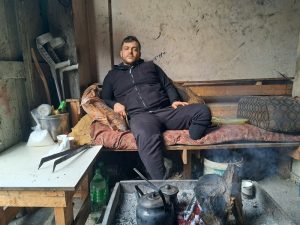
“I don’t belong to any party and I have no military interest. I don’t know why I have been denied,” said Mahmoud while drinking a cup of tea in front of a wood-burning stove in a small garage at his house in southern Gaza.

He was also diagnosed with cancer in the same leg in March 2021, during the COVID-19 pandemic. He was given chemotherapy in an isolation room at a hospital for nine months.

“My daughter was born the same day I entered the isolation room. Imagine, I didn’t see her or any of my family for nine months, except online. Much worse than exile,” he said.

Eventually, he contracted osteomyelitis, a serious bone infection requiring additional surgeries and intensive antibiotic therapy. Coupled with the cancer, his leg was eventually amputated under the knee in December.

“I underwent tens of surgeries since the injury,” Mahmoud said, leaving him unable to work. He had to shut the grocery store he used to run near the Gaza port, and which used to secure him a monthly income of some $1,500.

He still owes over $10,000, to traders and the landlord, and is finding it impossible to service his debt on the amount he now gets from social services.

“The ministry of social development gives me only 600 shekels [roughly $160] monthly, and I struggle to make ends meet. I also owe $200 to a nearby pharmacy as I bought my medicines at my expense.”

And his medical woes are not over. The cancer has not gone away and he also suffers a bacterial infection. He is yet again trying to secure permission to travel abroad for treatment.

“If I don’t travel, they will amputate another part of my leg soon.”

Hobbled and barred from travel

Wasim Abu Ajwa was 17 when he was shot in the leg in August 2018.
A young man sits on a bench with his leg in a splint
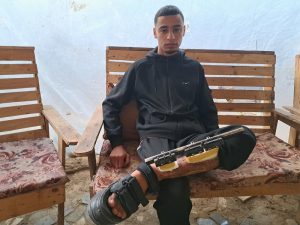
Wasim Abu Ajwa Ahmed Al-Sammak

“I didn’t even throw a stone,” he told The Electronic Intifada.

He underwent emergency surgery and stayed in hospital for 19 days. He then completed his treatment with help from Medecins Sans Frontieres (MSF).

The bullet had crushed 15 cm of his bone, and he underwent several surgeries in Gaza. MSF transferred him to Jordan in 2019 but he was told his bone had not grown back properly, so he went back to Gaza feeling desperate.

He managed to travel to Egypt in January 2020 for osteoplasty surgery to repair the bone. Five months later, he had to travel to Egypt for further surgery. This time, he was denied a travel permit for “security reasons,” even though he does not belong to any party.

“I tried to travel to Egypt three times but all in vain. I have been denied since then,” Wasim added.

Every aspect of his life has been affected.

“I can’t work or even walk a short distance as there is a 10-cm gap in my injured leg. My salary is 600 shekels [approx $160], which is the only income for my six siblings. I need limb lengthening surgery abroad, and after it, up to two years to fully heal.”

MSF was one of the main medical service providers for the injured in the Great March of Return, admitting nearly 5,000 patients to their trauma clinics, and carrying out some 4,000 surgeries.

However, the medical aid organization ended its services for almost all the injured in September 2019 and handed them to the Ministry of Health.

This has badly affected the casualities, many say.

“MSF’s services were VIP. They used to offer us everything; they were like a hospital, not a clinic. The governmental service is very bad,” said Wasim.

When Maysara al-Daya, 33, was shot in his leg in March 2018, he underwent a couple of surgeries during the first month. Then he started suffering from infections.

“Then I was diagnosed with cancer in my leg so I took chemotherapy and spent three months in an isolation room at hospital due to COVID-19,” said the father of two.

He applied to travel for treatment seven times in 2018, but was denied every time. After two rejections, Egypt allowed him to travel in 2019 when he had bone marrow transplant surgery. He has tried to go back, but has been denied since, he told The Electronic Intifada.

Then his condition got worse, and his leg was amputated just above the knee in March 2022. But he contracted a severe infection and other complications, resulting in another amputation two months later.

More complications and more surgeries. In all, he has had four amputations, the last in November.

He’s keeping count.

“I’ve had 89 surgeries since 2018. I’ve stayed at the hospital more than at home,” he said as he took two pills for his pain.

Maysara has suffered diabetes, high blood pressure and some issues with the kidney and liver, which he attributes to the quantity of medicine he is taking.

“If I had been allowed to travel immediately after my injury, I wouldn’t have gone through all this,” Maysara reflected bitterly. He still suffers from bacterial infection.

“If I can’t travel, I will have to amputate another part of my leg soon.”
Posted in Uncategorized | Comments Off on After the great march, the long recovery

ERASMUS IN GAZA


New Weapons Research Group è un gruppo di accademici, ricercatori medici e attivisti che si occupa di studiare e denunciare gli effetti delle armi più recenti sulle persone, in particolare donne e bambini.

Gli ospedali della striscia di Gaza, in particolare i reparti di maternità e pediatria, sono carenti di attrezzature e farmaci, indispensabili per la cura dei bambini. Questa situazione è dettata dal blocco a cui Gaza è sottoposta da anni.

Per questo, in occasione della proiezione del film a ingresso libero “Erasmus in GAZA”, lanciamo questa raccolta fondi che ha come obiettivo l’acquisto di farmaci e attrezzaturedestinate all’Ospedale Rantissi – Unità di dialisi pediatrica – Gaza.

Qualsiasi contributo è importante e può fare la differenza, sostieni anche tu gli ospedali di Gaza.

Cogliamo l’occasione per invitarvi alla proiezione del film “Erasmus in GAZA” di Chiara Avesani e Matteo Delbò, a cui seguirà dibattito, presso la Sala Polivalente San Salvatore in Piazza Sarzano 8 a Genova il giorno 21 marzo 2023 dalle ore 17:00 alle 20:00. L’evento è gratuito ed è accreditato come Attività Didattica Elettiva del Corso di Laurea in Medicina e Chirurgia.

Il film racconta di Riccardo, studente di Medicina, che ha trascorso un semestre a Gaza, tra reparti e pronto soccorso degli Ospedali. Una testimonianza diretta della drammaticità della guerra, un’esperienza di formazione, di amicizie, un viaggio in una città sotto assedio, uno sguardo inedito sulla Palestina.

Aiutaci a portare farmaci e attrezzature negli ospedali di Gaza, insieme possiamo donare speranza e cura

Posted in Blockade | Comments Off on ERASMUS IN GAZA

‘Weapon watching’ presentato a Genova il manuale per l’osservazione del transito delle armi

https://www.youtube.com/watch?v=m-dRCZQSumo

Posted in War | Comments Off on ‘Weapon watching’ presentato a Genova il manuale per l’osservazione del transito delle armi

Gaza warns landfill fire could rage for days, appeals for help

Gaza warns landfill fire could rage for days, appeals for help. [Mohammed Asad/Middle East Monitor]

Gaza warns landfill fire could rage for days, appeals for help. [Mohammed Asad/Middle East Monitor]

March 3, 2023 at 2:39 pmsharethis sharing button

Gaza officials called for help to extinguish a fire that started in a landfill in a village bordering Israel on Thursday, saying it could last for days and cause “an environmental catastrophe”, Reuters reports.

A large cloud of heavy smoke billowed into the sky as night fell, and there was a strong smell of burning rubbish across Gaza City.

The fire started “in the eastern part of a landfill in Juhr Al-Deek, south-east of Gaza City, near the separation fence, for reasons that have yet to be confirmed,” the Gaza Municipality said in a statement.

READ: Striking Gaza contractors: UNRWA owes us more than $20m

“We fear the fire might spread across the landfill and result in an environmental catastrophe.”

Local fire crews did not have the capacity to cope with the blaze, it added. The Authority called on international organisations to help put out the blaze, and for international pressure on Israel to lift a blockade to let equipment in.

Citing security concerns, Israel has enforced a blockade of Gaza since the Hamas Movement seized control of the densely-populated coastal enclave in 2007, restricting the movement of people and goods.

Palestinians say these restrictions, including on what Israel defines as “dual-use” items that could have a military purpose, have severely impeded their ability to respond to emergencies.

Last November, a fire broke out in a residential building in a refugee camp in the north of the strip, killing 21 members of a family and injuring several others

Posted in Blockade | Comments Off on Gaza warns landfill fire could rage for days, appeals for help

Behind the story, there are many other stories

Filed by Tareq S. Hajjaj

It is common in my work to go into the field for one specific story and discover many other stories inside it. Sometimes I feel that the Gaza Strip is the homeland of original stories. But unfortunately, many of these stories are painful.

I was writing a story about the power cuts in Gaza recently, so I went to a family’s home to live with them for a full day. I wanted to tell the family’s whole story and share how they cope with receiving only 3-4 hours of electricity daily during Gaza’s cold winter weather. However, spending the entire day with this family was difficult as I witnessed all the other issues facing this family in addition to their lack of electricity.

Ibrahim Al-Bala’wi’s family in the Jabaliya refugee camp welcomed the Mondoweiss team to observe their day for our story. We sat among them as they started their daily routine.

It’s worth mentioning that a brother and a sister in this family are disabled. They both have suffered permanent damage to their feet and legs; the brother was injured by Israeli fire during the Great March of Return, and the sister’s feet were amputated following a heart attack. Riham Al-Bala’wi, 33, this sister, is also a divorced mother with three children.

I told them that my story is about their struggle with the power cuts during the winter, but speaking to them only about this matter was impossible. They couldn’t just discuss the difficulties they face due to the lack of electricity without also telling me about their struggles getting medication, food, and fulfilling their children’s needs. And I had to listen.

“Since the moment I had a heart attack and started to lose my strength, my husband abandoned me and his three kids,” Riham tells me.

The man feared his wife would need special medical care and medication that his economic condition could not provide, so he left his family.

Riham moved into her father’s home, which is very small, but he welcomed her and her children despite his poverty as well.

One of the biggest problems during my work is that people think I work for a humanitarian organization that helps people financially. I often have to tell them I’m only a journalist and have nothing to do with providing aid. But they sometimes keep contacting me over and over to give them some help. Sometimes I share their stories with some kind friends of mine to see if they can help them, but I can’t always do this.

Riham struggles not only with her divorce and raising three kids but she also has difficulty getting the medical care she needs. She wants to receive an artificial limb, as she is now facing a complete leg amputation, but the government has informed her that it won’t be able to help cover the costs, making it impossible for her.

In the small house Riham shares with her family, she is not the only person who suffers, but as a woman in Gaza society, she is different from her brother Mohammed, 32, who is a father of five kids and lives in the same house with his parents.

Mohammed had his foot amputated due to his wounds in the Great March of Return, but he is now working as a delivery driver in a small motorized “TukTuk” despite his condition. He has been forced to work to feed his family as neither the government nor private charitable organizations have been able to give him support.

It’s a lot of pain and suffering inside one small house, but honestly, this is the reality of our society in Gaza. No home is without any pain. In every family, there is at least one story about suffering. The reason behind this is not only that we live in Gaza, but ultimately it is due to the Israeli occupation, which prevents all people in Gaza from enjoying our rights.

If we had an independent state, these cases could be adopted by the government, and they would maybe receive a monthly salary to help themselves and their families and get financial support for their medical care. But this is not the case. We will keep suffering until this occupation ends.

Posted in Blockade | Comments Off on Behind the story, there are many other stories

Israel introduces bill to limit medical treatment for Palestinian prisoners

If passed, legislation would prevent prisoners from receiving treatment beyond basic health care
Palestinian women attend a protest in solidarity with female Palestinian prisoners held in Israeli jails in Gaza city on 22 December 2021 (AFP)

Israel‘s parliament on Thursday passed the first stage of a bill to stop funding non-essential medical treatment for Palestinians in Israeli prisons, in the latest series of punitive measures taken against detainees.

The authors of the bill, which was supported by 42 Knesset members, described Israel’s existing prison policy as “unreasonably lenient” towards security prisoners.

It is unclear what the authors of the bill deem as non-essential medical treatment.

The bill was introduced by the Jewish Power, the party of far-right National Security Minister Itamar Ben-Gvir, and the opposition National Unity Party.

‘Slowly killing’ prisoners

Zaher Birawi, chairman of the civil society organisation Europal Forum, told Middle East Eye that the legislation is aimed at “slowly killing” Palestinian prisoners.

Such policies have been implemented against Palestinian prisoners for decades, Birawi said, but now “they are taking on legitimacy through the Knesset”.

The bill also stipulates that in exceptional cases, the national security minister, in consultation with the defence ministry, may authorise the funding of treatments for special reasons.

Birawi believes that, if passed, the bill would be tantamount to the “legalisation of medical negligence and as a means of punishment or even execution”.

In recent months, Ben-Gvir has set his sights on Palestinian prisoners in Israeli jails.

Since joining Prime Minister Benjamin Netanyahu’s government late last year, the security minister has vowed to crack down on the treatment of Palestinian prisoners, whom he claims are being treated too well.

Earlier this month, Ben-Gvir ordered the closure of Palestinian prisoner-run bakeries in Israeli prisons and that detainees would only be given four minutes to shower.

The head of the Palestinian Prisoner’s Club, Qadura Fares, condemned the latest move as a breach of international laws that guarantee “the right to treatment and health care for prisoners” by the occupying power.

In statement, Fares added that Israel continues to “ignore everything that has been approved by the international system, without any concern, and in light of international silence, the occupation authorities will continue to invent racist legislations and laws”.

‘Inflaming public opinion’

In toughening the conditions of Palestinian prisoners, such policies are aimed at responding “to a wide public perception that Palestinian prisoners enjoy relatively good treatment in Israeli jails”, said Yonatan Touval, an analyst at the Israeli Institute for Regional Foreign Policies (Mitvim).

In response, Palestinian prisoners in jails across Israel have began a series of mass civil disobedience actions to protest against punitive measures.

The actions will culminate in a hunger strike at the start of the Muslim month of Ramadan in late March, prisoners declared last month.

Ben-Gvir’s move against Palestinian prisoners also allows him to “claim that he is delivering on his election promise to lead a tougher stance on law and order, especially as he lacks any practical and meaningful policy that would boost security on the ground”, Touval told MEE.

Within the first week of the new government’s formation in December, Ben-Gvir announced plans to implement several punitive measures against incarcerated Palestinians.

Approximately 140 Palestinian prisoners have been transferred to Israel’s infamous Nafha prison, located in the southeast Negev desert, in recent weeks. The prison is notorious for its terrible living conditions that some prisoners describe as “inhumane”.

Touval believes that while Thursday’s bill still needs to pass two more stages before becoming law, the cumulative impact of Ben-Gvir’s policies bears risks.

“The state of Palestinian security prisoners is an extremely sensitive issue for Palestinians throughout the occupied territories,” he said.

Tensions in the West Bank are already at a boiling point, with at least 14 Palestinians killed by Israeli forces this week alone. So far this year, 62 Palestinians and 10 Israelis have been killed.

“Any deterioration in the conditions of Palestinian prisoners could inflame public opinion across the West Bank and the Gaza Strip,” said Touval.

“Given the recent escalation in violence on the ground, the additional pressure that the Israeli government is now putting on Palestinian prisoners could prove to be explosive.”

Posted in Blockade | Comments Off on Israel introduces bill to limit medical treatment for Palestinian prisoners

PCHR Sends Submission to Special Rapporteur on the Negative Impact of Unilateral Coercive Measures on Enjoyment of Human Rights

On Sunday, 26 February 2023, the Palestinian Centre for Human Rights (PCHR) sent a submission to Professor Alena Douhan, the Special Rapporteur on the negative impact of unilateral coercive measures on the enjoyment of human rights, in response to her call for submissions to inform her thematic report for the 54th Session of the UN Human Rights Council (September 2023).

The submission highlights the violations of the right to health committed by Israel, as an occupying power that bears the responsibility of ensuring and respecting the rights of Palestinians under its control. The submission also explains the negative impact of the Israeli restrictions on the Gaza Strip residents’ right to the highest attainable standard of health, including their access to healthcare at the hospitals in the West Bank, including East Jerusalem,Israel, and abroad.

The submission provides an overview of the serious heath situation in the Gaza Strip and the suffering of patients, particularly those with chronic and serious diseases, in light of the perpetual and chronic shortage of drugs and medical supplies, and lack of medical equipment and specialized medical personnel. Moreover, the submission reviews the Israeli occupation authorities’ obstruction of the entry of advanced medical devices to treat patients in the Gaza Strip, including the radiotherapy machine that is used to treat cancer patients.

The submission also tackles the occupation authorities’ restrictions on the travel of thousands of patients referred for treatment abroad, as they have serious diseases whose treatment is not available at the Gaza Strip hospitals.

PCHR recommended in the submission that the Special Rapporteur calls upon Israel to:

  • Fulfill its legal obligations as an occupying power towards the Gaza Strip, as the primary responsibility for providing medical supplies to the Gaza Strip population lies with the Israeli occupation in accordance with Articles (55) and (56) of the Fourth Geneva Convention of 1949, and
  • End the illegal and inhuman closure imposed since 2007 and the collective punishment policy imposed on the Gaza Strip population, including closure of the crossings to patients and humanitarian cases, to allow the travel of patients whose treatment is not available in the Gaza Strip hospitals.

For the Submission click here

Posted in Blockade | Comments Off on PCHR Sends Submission to Special Rapporteur on the Negative Impact of Unilateral Coercive Measures on Enjoyment of Human Rights

“Israeli forces made sure that many of the injured lost their lives”: The barriers to emergency healthcare in the West Bank

International law requires that health workers operating in occupied territory be permitted to conduct their life-saving work without fear of attack or obstruction. Violations against Palestinian healthcare workers and facilities, however, have long been a feature of Israeli military violence in the occupied Palestinian territory.

In 2022 alone, 105 health workers were injured, including by live ammunition and rubber-coated steel bullets, 77 ambulances were obstructed from accessing the wounded and 44 were damaged. This trend sadly persists in 2023. From assaults against medical teams to the obstruction of ambulances, the health and wellbeing of staff and patients is being put at risk.

The Palestine Red Crescent Society (PRCS) documented 11 violations against their medical teams in the West Bank in January alone. Israeli soldiers delayed or denied PRCS medical teams from reaching injured Palestinians 10 times and – on 13 January in Beit Ummar [Hebron] – fired rubber-coated steel bullets which damaged one of their ambulances.

During the recent Israeli military raid on Jenin refugee camp, which killed 10 Palestinians including a 61-year-old woman, all six of the PRCS ambulances that responded to the emergency were prevented from accessing the camp. “Two hours later, and in light of the increasing numbers of casualties and injuries, our crews were allowed to enter after coordinating through the International Committee of the Red Cross. As we moved into the camp, we still experienced warning shots near the ambulances,” said Azzam Nimer, Head of the Emergency and Ambulance Department at PRCS.

“Israeli forces allowed our medical teams in after they made sure that many of the injured lost their lives. This is not the first or last time that Israeli forces will impede the access of medical teams and wait until the injured bleed to death.”

“We expect cities to be closed and an influx of injuries at any moment”

As well as escalating violence, Israeli forces have further restricted Palestinians’ freedom of movement, including health workers and patients, and even closed off cities completely. In occupied East Jerusalem recently, PRCS medical teams faced prolonged inspections by Israeli forces at checkpoints, delaying their access. This threatens the lives of patients for whom every minute counts.

On 6 February, Israeli forces shot dead at least five Palestinians during a raid on the Aqabet Jabr refugee camp in Jericho, which was closed off for more than a week. PRCS medical teams were prevented from reaching the injured and their ambulance came under attack.

This follows a previous Israeli military raid two days before, where PRCS reported that their ambulances were blocked from treating the injured Palestinians, including three Palestinians who were shot with live ammunition.

Then, on 13 February, an Israeli military vehicle was filmed blocking PRCS paramedics from helping Palestinians injured during an Israeli military raid in Nablus, which killed one Palestinian and injured seven others.

“Given the situation in the West Bank now, we expect cities to be closed and an influx of injuries at any moment,” said Azzam. “We are now treating each city as an isolated territory. I have to make sure that each city has a separate warehouse with enough emergency disposables and medications that can last for three months. The Israeli army can just close a city for weeks, like [last year] in Nablus, and this makes our medical response very complex.”

In the neighbourhood of Shu’fat, in East Jerusalem, PRCS also reported how their emergency teams recently faced delays and hostility from Israeli forces. Soldiers demanded to see their ID cards and interrogated them over the cases of patients they were trying to respond to.

Palestinians are segregated by an ID system, meaning those with a green West Bank ID must obtain a permit from Israeli authorities to cross the separation wall and access East Jerusalem. According to PRCS, paramedics who have West Bank ID cards have recently been barred from immediate entry into Shu’fat refugee camp, despite having permits that allow them to cross any other checkpoints.

The ID system has also impacted patients. Injured Palestinians or their family members have opted to take private cars instead of ambulances, as they fear that being in an ambulance and facing interrogations and ID checks could delay their journey to emergency care.

In 2021 and 2022, Medical Aid for Palestinians (MAP) provided two fully-equipped ambulances and a field hospital tent to the PRCS in East Jerusalem, as well as other essential supplies and equipment. We have also provided primary trauma care training for PRCS paramedics. But, as Israeli military and settler violence continues to occur on an almost daily basis, the PRCS needs more medical supplies, equipment and ambulances to respond to increasing violence.

But as well as urgently responding to the critical health needs, Azzam says urgent action is needed from the international community: “Even if we have all the requested needs, we will still face the obstacles and violations against our teams that come from working under occupation. We need your support to protect our health workers and ensure Israel is held accountable for violating their basic rights so that they can continue to save lives without coming under attack.”

https://www.map.org.uk/donate/donation-details/460

Posted in Blockade | Comments Off on “Israeli forces made sure that many of the injured lost their lives”: The barriers to emergency healthcare in the West Bank

International Childhood Cancer Day: for “Better Survival,” PCHR Demands Better Access to the Highest Attainable Standard of Health for Gaza Children with Cancer

February 15th marks International Childhood Cancer Day (ICCD), a global collaborative day created as an annual event by the Childhood Cancer International (CCI) in 2002. This year’s campaign is launched under the theme “Better Survival” to raise awareness about the risks of cancer, the challenges facing children with cancer through prevention, early detection and appropriate treatment of cancer as well as supporting their families.


On this occasion, the Palestinian Centre for Human Rights (PCHR) draws attention to the suffering of the Palestinian children with cancer, including 350 children living in the Gaza Strip and facing a difficult and lengthy journey of treatment due to the Israeli occupation authorities’ practices and the repercussions of the Palestinian political division. These children suffer from the Israeli-imposed restrictions on their travel with their companions for treatment outside the Gaza Strip. They also suffer from lack of specialized medical personnel, poor diagnostic equipment, and lack of many treatment protocols and medical supplies.

Children with cancer receive medical care at Al-Rantisi Hospital, the only hospital that provides pediatric cancer treatment in the Gaza Strip yet suffers from a perpetual shortage in the list of essential drugs and many important medical equipment used for diagnosing cancer, as the hospital services are only limited to chemotherapy, supportive treatments and other healthcare services.  This forces patients to complete their treatment in hospitals outside the Strip, and so their suffering from the Israeli restrictions on their travel begins. Leukemia is the most common cancer affecting children in the Gaza Strip, where 86 children with leukemia received treatment last year while 182 children continue treatment in the post-recovery phase on a regular basis at Al-Naser and Al-Ranitisi Pediatric Hospitals. [1]


The restrictions imposed by the Israeli occupation authorities on the travel of children and their companions for treatment abroad are among the most prominent obstacles that prevent children from receiving treatment. In 2022, IOF obstructed 272 out of 1000 requests (i.e. 28% of the total number of applications[2]) for children referred for treatment abroad, leading to the death of 3 children due to obstructing their travel by the Israeli occupation. Meanwhile, in the same year 16 children died with cancer in the Gaza Strip.


The Israeli authorities prevent a number of parents from accompanying their children for treatment outside the Gaza Strip. Since the beginning of 2018 to 2021, 43%[3] of the children referred for treatment abroad had to travel without one of their parents because their requests to travel via Beit Hanoun “Erez” crossing were denied or delayed. This hereby affects the mental health of these children who already suffer from serious health conditions and in dire need of one of their parents as a companion during their treatment.


Moreover, the ongoing Palestinian political division causes the level of health services provided by hospitals and healthcare centers for cancer patients in the Gaza Strip to deteriorate, impeding the localization of health services, the adoption of a medicines policy that ensures the availability of treatment for all citizens, and the provision of all medical equipment for the governmental health facilities. All of this is due to not allocating sufficient and necessary budgets to cover the shortage of essential medicines and medical equipment needed for the treatment of cancer patients. According to the Palestinian Ministry of Health (MOH) in Gaza, the list of essential drugs used for the treatment of patients with cancer and blood disorders that are at zero-stock reached (37%), as 23 out of the 63 types of essential drugs ran out in December 2022.


Around 9,000 cancer patients in the Gaza Strip suffer from disastrous health conditions due to the acute shortage of medicines and medical supplies required for their treatment at Gaza hospitals. On the other hand, the Israeli occupation authorities continue to impose restrictions on the entry of new medical devices and laboratory materials necessary for cancer patients’ tests. These challenges deny patients’ access to treatment services appropriate to their serious health status. Also, the MOH expects to record (2000) new cancer cases in 2023 while the number of cancer patients recorded in 2021 was 1952 in the Gaza Strip. Additionally, there were 610 deaths recorded in the same year.


PCHR emphasizes that cancer patients in the Gaza Strip, including children, should enjoy their fundamental rights, including the early and accurate diagnosis, right to have essential life-saving drugs, right to receive adequate and qualitative treatment, and to have “better survival” opportunities for recovered patients. On this occasion, PCHR is deeply concerned over the lives of children with cancer in the Gaza Strip. Thus, PCHR:


  • Appeals the international organizations, including the World Health Organization, to support the health system in the Gaza Strip in order to improve its current capabilities relevant to diagnosing and treating sick children, and provide necessary medicines and medical devices to ensure high recovery rates among children with cancer in the Gaza Strip.
  • Calls upon the international community to exert pressure on the Israeli occupation authorities in order to end all restrictions imposed on patients’ travel, especially children with cancer.
  • Calls upon the international community to exert pressure on the Israeli occupation authorities in order to allow the entry of Radiology devices necessary for diagnosing cancer.
  • Calls on the Palestinian Ministry of health in Ramallah and Gaza to coordinate with each other and work on allocating operational expenses to purchase medicines and medical consumables for cancer patients to end their shortage, and to ensure that patients receive their right to the highest attainable standard of physical and mental healthcare.
 

for more information, please call PCHR office in Gaza, Gaza Strip, on +972 8 2824776 – 2825893

Gaza- Jamal ‘Abdel Nasser “al-Thalathini” Street – Al-Roya Building- Floor 12, El Remal, PO Box 1328 Gaza, Gaza Strip. E-mail: pchr@pchrgaza.org, Webpage http://www.pchrgaza.org

If you got this forwarded and you want to subscribe, send mail to  request@pchrgaza.org

and write “subscribe” in the subject line.

To unsubscribe, send mail to  request@pchrgaza.org

and write “unsubscribe” in the subject line.

for assistance: info@pchrgaza.org

Posted in Blockade | Comments Off on International Childhood Cancer Day: for “Better Survival,” PCHR Demands Better Access to the Highest Attainable Standard of Health for Gaza Children with Cancer