Pollution on tap in Gaza

People in Gaza rely on water from public filling stations.

Youssef Abu Watfa APA images

Sana Abu al-Ata is constantly waiting for water.

She often keeps the faucets open so that she will be able to hear the sound of liquid flowing through them. Sometimes she stays awake all night, listening.

Water arrives at irregular intervals in her home. And when water does arrive, it is invariably of poor quality.

“The water is so salty,” said Abu al-Ata, a resident of Deir al-Balah refugee camp in central Gaza. “It’s like it comes straight from the sea. It damages our skin and hair.”

After a rash appeared on her daughter’s skin, she was advised to use bottled water while washing.

Costing around 60 cents per liter, bottled water is unaffordable for most people in Gaza, where poverty and unemployment are widespread. Bottled water has increased in price over recent months – along with food and drinks generally.

“Complete control”

Access to water is among the many issues examined by Amnesty International in its recently published report documenting how Israel runs an apartheid system.

The report states that “Israel has consolidated complete control of all water resources and water-related infrastructure in the Gaza Strip, including the coastal aquifer, which is the only freshwater resource in Gaza.”

Due to over-extraction and pollution, more than 95 percent of water from the coastal aquifer is unfit for human consumption.

No transfer of water from the occupied West Bank to Gaza is allowed by Israel, the Amnesty report adds.

Israel, the occupying power, charges hefty sums to supply Gaza with water. The annual bill paid to Israel is around $20 million.

Importing from Israel is necessary, according to Mazen al-Banna, a senior Gaza-based representative of the Palestinian Water Authority. The coastal aquifer does not yield enough water to meet the needs of farmers, factories and households.

“We live in a narrow geographical area,” al-Banna said. “This means that water resources are limited.”

Rather than demand that Israel ensures all Palestinians have access to clean water, some high-ranking diplomats have actually praised Israel’s inherently racist policies.

In November last year, the UN Middle East envoy Tor Wennesland noted that Israel had taken steps towards selling an additional 5 million cubic meters of water to Gaza per year. That, according to Wennesland, was a “positive development.”

Unaffordable

Not all diplomats share Wennesland’s habit of sugarcoating the occupation.

In September, Michelle Bachelet, the UN’s high commissioner for human rights, presented a report which criticized Israel’s destruction of Palestinian infrastucture. The report stated that around 290 water and sanitation facilities were destroyed or damaged by Israel when it attacked Gaza in May.

Bachelet’s report observed that safe drinking water has become “virtually unaffordable” in Gaza, where poverty and unemployment are widespread.

Some 20,000 families do not have enough money to buy clean water. Those families rely, according to Bachelet’s report, on “water from public filling points or unsafe tap water, with high risk of waterborne diseases, particularly among children under five.”

The water from Muhammad al-Zaanin’s faucets is usually colored gray or yellow.

“We just use tap water for cleaning and bathing,” said al-Zaanin, who lives in Beit Hanoun, northern Gaza. “The water doesn’t seem suitable for anything but we have no choice. When my kids take a shower, they complain that their eyes get sore and red. Their hair tends to be very dry and they need moisturizers for their skin.”

Polluted water causes damage. Al-Zaanin recently had to change taps and siphons in his bathroom because they were clogged with rust and lime.

“It was very expensive,” he said. He also noted that the water is too dirty even for the plants and fruit trees in his garden.

The problems of access to water have been compounded by the full blockade which Israel has imposed on Gaza for more than 15 years. One consequence of the siege is that Gaza frequently encounters power outages.

Abed Omar is a father of five living in Beach refugee camp, Gaza City. The pump which he uses to fill containers with water runs on electricity.

In the winter, his family usually has access to water for five hours per day. But during summertime, they tend to only have water once every two or three days.

“When we don’t have water and electricity at the same time, we can’t fill our containers,” he said. “So we have no water for days at a time. It is so difficult.”

Fedaa al-Qedra is a journalist in Gaza.

Posted in Blockade | Comments Off on Pollution on tap in Gaza

kidney patients suffering for strict “Israeli” siege

bd29f237-04be-4087-9df6-63d4cc02f229

the Ministry of Health in the Gaza Strip stated that kidney patiens suffer constantly due to the strict”Israeli” siege, pointing out that there are 1.026 patients with kidney failure

Posted in Blockade | Comments Off on kidney patients suffering for strict “Israeli” siege

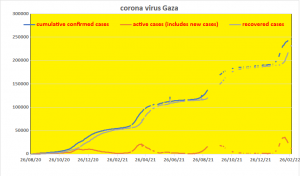
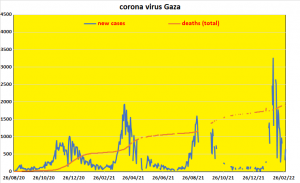
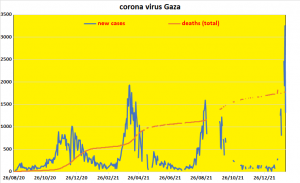
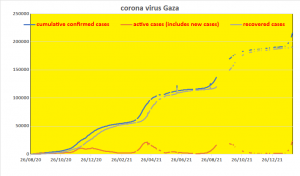
Covid data from MoH Gaza, up to March 1, 2022

The decline of new infections and active cases in the last week is confirmed, indicating the slow down of this 4th rise of the infection.

Vaccinated are 657.151 at this date.

Posted in Covid-19 | Comments Off on Covid data from MoH Gaza, up to March 1, 2022

Support this initiative proposed by European Union citizens

Ensuring Common Commercial Policy conformity with EU Treaties and compliance with international law

We seek to regulate commercial transactions with Occupant’s entities based or operating in occupied territories by withholding products originating from there from entering the EU market. The Commission, as Guardian of the Treaties, has to ensure consistency of Union’s policy and compliance with fundamental rights and international law in all areas of EU law, including CCP. It must propose legal acts based on the Common Commercial Policy to prevent EU legal entities from both importing products originating in illegal settlements in occupied territories and exporting to such territories, in order to preserve the integrity of the internal market and to not aid or assist the maintenance of such unlawful situations. The initiative thus invites the Commission to submit a proposal for a legal act under the Common Commercial Policy which is general in nature and does not target a specific country or territory.

Posted in Uncategorized | Comments Off on Support this initiative proposed by European Union citizens

State Accountability for the Good Health of Palestinians Has Failed: What Can the Global Health Community Do Next?

source

Mohammed Alkhaldi, Rachel Coghlan, Simon Miller, Aisha al Basuoni, Osama Tanous, and Yara M. Asi

Introduction

In early June 2021, Scientific American published a statement by health care workers, calling on health care systems, academic institutions, and health care professionals in the United States to “unequivocally condemn Israel’s long-standing oppression of the Palestinian people” and the ongoing decimation of their health.1 Similar statements were issued by other health professional groups.2 These statements of solidarity with the Palestinian people came following the May 2021 deadly bombings in the Gaza Strip and violence in the West Bank and East Jerusalem, and amid a shifting global recognition of the realities of systemic discrimination, racism, and settler colonialism against Palestinians in the occupied Palestinian territories (oPt) and Israel. Around the world, awareness has been growing of the illegal and immoral crimes committed against Palestinians by Israeli government policies, soldiers, and settlers, and of the impacts on health resulting from persistent oppression amid this profound power disparity.

The Scientific American solidarity statement has since been retracted, replaced with an editor’s note that the article “fell outside the scope of Scientific American.” The same day this statement was initially published, BMJ Opinion featured an article highlighting the dangerous new precedent for political censorship on Palestine in academic journals.3 This opinion piece described the publishing and subsequent retraction by the Lancet from its website and print journal of a letter on the potential devastation of COVID-19 in Gaza. While the letter remains accessible through other sites, it has been removed from the Lancet journal itself.4

As public health academics and practitioners working around the world who believe in the right to health as a basic human right, closing the health equity gap and the attainment of universal health coverage, the importance of evidence-based health care, and the ethical principles of ensuring good health and well-being that underpin our health education and training, we fully support the call to action from health care colleagues originally published by Scientific American, and we are appalled that their voices have been silenced post-publication.5 Further, we appeal to all health care scientists and professionals, health care organizations, global health academic institutions, and global health academic journals to take steps to hold to account the states and institutions that deprive people anywhere, including Palestinians, of their right to health, and to reproach any attempts to censor calls for the realization of this right. Building on recent global momentum, we propose the establishment of an independent observatory of prominent and powerful health professionals and institutions to ensure a more effective accountability mechanism for the health of Palestinians.6

Health as a universal human right, “without distinction of race, religion, political belief, economic or social condition,” was first agreed on by states in the Constitution of the World Health Organization and the Universal Declaration of Human Rights, and enumerated in many international agreements since.7 Ironically, the Universal Declaration of Human Rights was adopted the same year that Palestinian people were initially dispossessed—1948, the year of the Nakba—and Palestinians living under Israeli settler colonial rule have since endured seven decades of violence, gross human rights violations, and poor health outcomes.8

Why, then, is there continued disregard by states and the wider global health community toward accountability for the good health of Palestinians, regardless of race, religion, or political belief? Bluntly put, state accountability for the health of Palestinians has failed. How can we, as a global health community, ensure such accountability and overcome the impunity afforded to Israel for its role in exiling Palestinians from their right to health? “Silence,” the health care workers wrote in their (paradoxically now-retracted statement), “is complicity.”9 We are at a critical new juncture—and silence is no longer an acceptable response.

The failure of global health accountability to protect the health of Palestinians

Accountability for health is rooted in international legal obligations and human rights. Israel has continued to ignore duties under international human rights law and the right to health—as well as its obligations under international humanitarian law as an occupying power—by denying Palestinians essential health resources, actively obstructing access to health care, and deliberately attacking health infrastructure.10 This denial and obstruction includes a stifling blockade of the Gaza Strip; a separation wall, expanding settlement infrastructure, and an extensive checkpoint system in the West Bank; and a medical permit system, controlled by Israel, for travel out of the West Bank or Gaza Strip to receive health care unavailable in the territories due to these same Israeli restrictions. Israeli authorities’ denial of permits, often without explanation, for Palestinians wishing to access urgent and often lifesaving health care outside Gaza and the West Bank has led to the unnecessary deaths and suffering of many patients, especially those with cancer.11 Moreover, the May 2021 period of heavy Israeli bombardment on Gaza led to the direct targeting of key roads and access routes, preventing ambulances from reaching hospitals and health clinics.12

While countries have scrambled to vaccinate their populations against COVID-19, Israel has unashamedly withheld vaccines from the Palestinian population.13 As of November 18, 2021, just over 53% of Palestinians across the West Bank and Gaza had been vaccinated, while Israel has been lauded for the success of its mass vaccination campaign of its own citizens.14 Last year’s escalation of violence increased the risk of likelihood of COVID-19 transmission, and damage to health facilities—including Gaza’s only COVID-19 diagnostic testing facility—hindered the ability to properly respond to the pandemic, as did the killing of Abu al-Ouf, the physician leading the pandemic response at the largest hospital in Gaza.15 In intensive care units, 36% of those admitted during the escalations were patients with COVID-19-related complications.16

In March 2020, Michael Lynk, the United Nations (UN) Special Rapporteur on the situation of human rights in the Palestinian territory occupied since 1967, appealed to Israel’s legal duty, anchored in article 56 of the Fourth Geneva Convention, to ensure all necessary preventive means available to combat the spread of contagious diseases and epidemics and ensure that Palestinians receive essential health services.17 In October 2020, Lynk reported to the UN General Assembly that “Israel as the occupying power has the primary responsibility to ensure respect, protection and fulfilment of the right to health of Palestinians in Gaza to the full extent of their actual control” and that the ongoing Israeli-imposed blockade on Gaza contravenes international law, specifically article 33 of the Fourth Geneva Convention, amounting to “the collective punishment of the entire civilian population in Gaza” and an experiment “in human despair.”18

Global health accountability mechanisms are supposed to exist to ensure that governments, health policy makers, and health systems follow through on their legal and moral duties to improve the health and well-being of all people, especially the most vulnerable.19 Accountability processes are supposed to play a vital role in driving progress toward health equity commitments that governments, institutions, and organizations have made.20 “Without accountability,” says Lynk on Palestine, “the possibility of political reconciliation, let alone its flourishing, is unattainable. And without accountability, social wounds metastasize, leaving unchecked retaliation, rather than measured restitution, as the likely response to the injustices of the past and present.”21

A number of multilateral mechanisms exist to keep Israel’s adherence to duties, including health, in check. The Office of the UN High Commissioner for Human Rights in the occupied Palestinian territory is responsible for monitoring and reporting publicly on the human rights situation there.22 The Special Rapporteur on the situation on human rights in the oPt, the Special Committee to Investigate Israeli Practices Affecting the Human Rights of the Palestinian People and Other Arabs of the Occupied Territories, and the UN Secretary-General himself regularly investigate and report on the situation in Palestine. The Security Council is the custodian for ensuring international peace and security and has the authority to impose international sanctions when peace and security are threatened. The World Health Organization’s Right to Health Advocacy program in the oPt works specifically to strengthen the monitoring of barriers to the right to health, including obstacles to health access and attacks on health care.23 Reports on progress toward Palestinians’ right to health are provided to member states at each World Health Assembly by the Director-General of the World Health Organization.24

But what have these mechanisms achieved to improve the health of Palestinian people? Israel continues to act with impunity under the world’s watch, other global powers allow this impunity without consequence, and private corporations continue to play a significant role in propping up and profiting from the illegal Israeli occupation and settlements. The veto powers of the permanent members of the Security Council undermine the very accountability mechanism that exists to maintain peace and security and perpetuate an agenda with colonial roots.25 Appeals—over decades—to Israel’s legal, human rights, and moral duties have fallen on deaf ears; and international condemnations for grave breaches to health rights and humanitarian law have failed to make Israel accountable in practical terms. Even the decision to report on progress toward Palestinians’ health at the World Health Assembly has caused division among member states.26 The international community of nation-states and key UN bodies have failed the Palestinian people. As Rashid Khalidi recently voiced to the UN Security Council:

Since the founding of the United Nations, the Security Council has passed multiple resolutions on the Palestine problem and the Israeli-Arab conflict. These issues that have taken up more of the time and energy of this body than any other global problem. Most of these resolutions have not been implemented or respected. They are dead letters. This systematic disrespect for Security Council resolutions, encouraged by the impunity I have described, has left this Council, and the United Nations itself, in justifiable disrepute. More seriously, this impunity has been a major obstacle to establishing peace, justice and security for all who live in Palestine and Israel.27

First steps toward accountability for the good health of Palestinians

In 2019, Lancet editor Richard Horton published an article titled “The urgent need to protect global health accountability.”28 What can be done? What can we do?

Achieving accountability for the good health of Palestinians will require that we as individuals and the organizations we work with and for do not allow a sense of helplessness to overcome us. The big-picture situation in terms of ending the occupation of Palestine undoubtedly needs resolution, but we as a global health community can take some immediate, smaller steps—including steps to hold accountable those who perpetuate the poor health outcomes and unnecessary suffering of Palestinians, and calling out those complicit in censorship.

Accountability means raising our united voices as health-focused institutions, organizations, and individuals to challenge settler colonization, racism, and asymmetries of power and demand that the health needs of Palestinians be met.

History has universally demonstrated that the cost of colonization and systemic racism is the good health of the colonized and subjugated. In the case of the Palestinian population, colonization, systemic racism, and conflict are root causes of adverse health outcomes, unnecessary suffering, and preventable deaths.29 There can be no accountability for good health if governments, institutions, and organizations continue to perpetuate imbalances of power by excusing policies and practices that support structural violence and oppression.

Discourse on the decolonization of global health has gained momentum in the past year, amid racial reckoning following the Black Lives Matter movement. The decolonizing global health movement fights against ingrained systems of dominance and power to improve the health of populations.30 We have a greater understanding of the impacts of systematic oppression and occupation on health; and now is the time to challenge and correct asymmetries of power and dominant discourse by promoting decolonial narratives with regard to the health of Palestinians.

For decades, improving the health of Palestinians has been framed as a “humanitarian issue” under the responsibility of the international community.31 Though humanitarian assistance to Palestinians is well intentioned, this framing relieves Israel of its duty as a belligerent occupying power to assure the good health of Palestinians. It also has the effect of categorizing Palestinians as a class of victims to be saved with donations, aid, and service provision by humanitarian actors. A more just and historically rooted approach would be to frame the situation as it is—an Indigenous population resisting a settler colonial regime in order to achieve sovereignty and rebuild its own health care system.

We have been encouraged by recent calls for the decolonization of journalistic reporting and academic scholarship on Palestine, as well as by academic solidarity in support of the self-determination and liberation of the Palestinian people against Israeli colonialism.32 We are also heartened by growing public support for Palestinians in all corners of the globe. Health professionals are increasingly rallying against health violations targeting the Palestinian people.33 The Lancet Palestinian Health Alliance, established in 2009 as a network of Palestinian and international researchers, has provided an important platform for research, advocacy, and action on health in Palestine.34 We are uplifted by the recent statements of health workers and professionals in the United States in support of Palestine, including the retracted solidarity statement.35

Now is the time to expand such statements and build on the work of the Lancet Palestinian Health Alliance and other collective efforts. Global health institutions and bodies, health academics, practitioners, and policy makers are “uniquely positioned to respond to the social, political, and economic structures affecting our patient’s health” and to act on evidence-based truths.36 It is incumbent on us to do so, and to do so collectively.

The first important step is to keep pressing forward with the decolonizing health discourse through formal statements and calls to action across all health systems, global health academic institutions and journals, and health care colleagues. We need a critical mass of health professionals and institutions campaigning for the right to health in Palestine.

In the immediate term, we must collectively call on Israel to do the following:

  • take responsibility for repairing and restoring the health care infrastructure decimated by the May 2021 bombings;
  • commit to a cessation of military and civilian violence directed toward the Palestinian people;
  • end attacks on health care workers and health care infrastructure;
  • permit free, easy, timely, and sustainable access to essential health services and goods in Gaza and the West Bank; and
  • permit free, easy, timely, and sustainable access for people requiring essential medical care outside of Gaza and the West Bank.

We must publicly reproach efforts to censor Palestinian voices and stories in favor of “balance” or the “cruel false equivalence.”37 It is incumbent on us as individuals and organizations in global health to hold accountable any person or organization that attempts to silence the voices of those who advocate for the good health of Palestinians.

Accountability means bolstering independent processes for monitoring and reporting on violations to the right to health, with sanctions imposed when the right is not met.

Israel continues to shrug in the face of immunity from consequences for violating legal duties and societal norms, a path smoothed by other dominant global powers and large private corporations. Despite credible monitoring and documentation on progress (or lack thereof) toward Palestinians’ health and human rights by institutions such as the World Health Organization and the Office of the United Nations High Commissioner for Human Rights, existing accountability mechanisms have failed. We propose bolstering independent mechanisms for health accountability toward Palestinians in the oPt, with representation, input, and lobbying from a formalized independent observatory of prominent and powerful health professionals and institutions.

There is precedent for such independent mechanisms. In 2012, the independent Expert Review Group on Information and Accountability for Women’s and Children’s Health was created in response to the failure of UN agencies, donors, and countries to achieve improvements in the health of women and children, and in recognition of the need to better track progress on and resources for women’s and children’s health. The group was made up of leading global health academics and practitioners, including Horton, editor of the Lancet, serving in an independent capacity. In their first progress report, the independent reviewers wrote that

our shared view is that independent accountability is, and will increasingly become, a powerful force to accelerate progress towards both national and international health and development targets … We want to see independent accountability not only become a new norm in global health, but also demonstrably improve the lives of women and children worldwide.38

Monitoring and reporting alone are not sufficient for successful accountability. A new and formalized alliance of powerful global health scientists and professionals, health care organizations, global health academic institutions, and global health academic journals committed to achieving the right to health, starting with Palestinians’ health, could achieve the following:

  • form a secretariat and seek registration as a nonstate observer to the World Health Organization;
  • use existing evidence to call on states to take action to enforce health and human rights norms; and
  • demand the enactment of sanctions when right to health violations are reported and key health outcomes are not met. This would include seeking an end to all partnerships with private corporations that uphold Israel’s occupation and oppression of the Palestinian people and revisiting all government aid that may perpetuate the occupation.

To have an impact that shifts the balance beyond politics as usual, such an observatory would require the support of powerful and respected public and private health institutions. Health advocates and institutions must be prepared to stand firm in the face of fear of reprisal, harassment, or silencing from any government, institution, or funding body.39

This observatory would help communicate to the world in a relatable manner the impacts of structural racism and oppression—for example, vaccination rates of the population of Israel versus vaccination rates for Palestinians; access to lifesaving cancer treatments for Israeli patients versus access to lifesaving cancer treatments for Palestinian patients; and advancements in health care resources, infrastructure, and technology in Israel versus the destruction of health care facilities in Palestine.

If proven effective in improving health-focused accountability for Palestine, such an independent observatory could also seek to achieve improved health across other contexts of occupation or conflict around the world where the right to health of people living in conflict is ignored or undermined, such as Syria, Yemen, and Myanmar—in this way aligning with and reinforcing the World Health Organization’s Health and Peace Initiative, which promotes a health care lens to address the underlying causes of conflict.40

Conclusion

There must be accountability for the acute and longer-term impacts on Palestinian health that flow from the bombings in Gaza and violence in the West Bank and East Jerusalem. Israel has not been held to account for the recent escalation of violence or for the willful obstruction of the passage of essential care and resources that would protect the Palestinian people from COVID-19. Israel has also not been held to account for creating and perpetuating the conditions that have led to the chronic degradation of the Palestinian health system and the poor health of Palestinians.

States that act to degrade the health of whole populations must not be permitted to continue doing so with impunity. It is time to end our tolerance for companies and institutions that are complicit with or support the structural violence of colonization and racism that is denying the good health of Palestinians—a right that all Palestinians are entitled to enjoy. Strengthening health accountability toward people living in conflict settings can open new avenues for assuring good health, ending oppression and violence, and building peace. As a global health community, we must raise our collective voices and reproach censorship and attempts to silence us.
Posted in Covid-19 | Comments Off on State Accountability for the Good Health of Palestinians Has Failed: What Can the Global Health Community Do Next?

gaza coronavirus up to 2022 february 17

Source: Ministry of Health, Gaza


Posted in Covid-19, Uncategorized | Comments Off on gaza coronavirus up to 2022 february 17

Palestinian Group Helps Gaza Children with Cancer in Jerusalem’ Hospitals

Many Palestinians have lost their lives since 2006, as Israel refuses to issue medical permits for those living in the Gaza strip. Over the past 16 years, Israel has imposed a blockade on the strip after Palestinian resistance group Hamas won the legislative elections.

While children affected with cancer do get medical permits to be treated in Jerusalem hospitals, their parents are not allowed to accompany them. They are either left alone in hospitals or one of the old grandparents is only allowed to attend to them.

Speaking to Anadolu Agency coinciding International Childhood Cancer Day, which is being observed on Tuesday, Nimah Alyan, 22, from Jerusalem, said that to overcome such issues, she has created an initiative to help cancer-affected children and their families.

“We were nine friends at the beginnings, today we are more than 20 volunteers from Jerusalem and its neighborhoods. This experience has made my heart a tender,” she said.

The idea to set up the group came when Alyan met the seven-month-old child Mayar, who had come from Gaza to Jerusalem after being diagnosed with a tumor in the retina. Although her mother was allowed to accompany her to Israeli Hadassah Ain Karam Hospital, she was unable to communicate with anyone in the hospital

“For more than ten days her mother did not know any clear details about her daughter’s health status, because she did not speak Hebrew or English. Because of this, the mother had days and nights of fear, she thought doctors would have surgery to remove her daughter’s eye,” she said.

Meanwhile, the mother herself got sick, as she was pregnant and was not able to take care of her ailing child.

Reeling under pressure, the mother sent a message to one of the social media activists in Jerusalem who forward the message to Alyan. A few hours later, Alyan was at the hospital with that activist.

“We talked to the medical staff there and they clarified for us the details of the situation in Hebrew. Language is one of the major challenges for the Palestinians who come from Gaza,” Alyan told Anadolu Agency.

They take children from the Beit Hanoun military barrier on the north of Gaza to Jerusalem in their cars, escorting them to the hospital and providing support during their chemotherapy and surgical treatment.

“Those who speak Hebrew stay with children to understand and follow up the medical situation for them and give these details for their families in Gaza,” she added.

Alyan highlighted that they are trying to help socially too by keeping the contact between the volunteers and the families of the children and performing supportive activities at the hospital to make these children feel safe and well.

“These children are a part of us, and their stories touch me deeply. For all my life, I can’t forget Mayar’s mother’s facial expressions when we told her that her baby wouldn’t lose her eye,” said Alyan.

In collaboration with Augusta Victoria Hospital’s cancer department, the initiative carries out voluntary entertainment activities frequently and assistance in the provision of accommodation supplies for children.

“When I see the sense of safety and reassurance in these children’s eyes, I realize the importance of what we’re doing, and we have to keep doing this,” she said.

Source: Anadolu Agency

Posted in Blockade | Comments Off on Palestinian Group Helps Gaza Children with Cancer in Jerusalem’ Hospitals

The healthcare crisis in Gaza demands immediate action to alleviate unnecessary suffering

Eleven-year-old Amal Lubbad was deep in thought when I met her in what has become her second home, Al-Shifa Hospital in Gaza City. It was her third hospital visit this week. Five years ago, Amal was diagnosed with kidney failure, which requires her to have dialysis. A kidney transplant would save her life.

She greeted me with a smile that masked the considerable pain which defines her past, present and future. The dialysis machine that she is usually connected to for hours on end has broken down. The parts needed to maintain it are not available in the besieged Gaza Strip. The Israeli occupation authorities won’t allow the necessary spare parts and equipment to be imported, so Amal’s health has worsened considerably. The kidney transplant is now needed as a matter of urgency; she can no longer afford to wait.

Broken dialysis machines and shortages of medicines and suitable treatment threaten the lives of nearly 600 Palestinian kidney patients in the Gaza Strip. Amal is not alone in waiting for a transplant; sitting next to her was Abu Ali, 70, who could barely speak. He too was sitting on a dialysis chair, his hands trembling. The nurse watched the dialysis machine anxiously, fearing that it would malfunction and stop working. An hour passed and it was still running, but everyone’s stress level continued to rise: Abu Ali requires three hours of dialysis a day. His eldest son Ibrahim accompanies him to his sessions at Al-Shifa, sometimes offering food or conversation to try to distract his father. Ibrahim told me about a day when the dialysis machine did break down mid-session, causing them to have to wait for a full day until the machine was serviced and repaired. All the dialysis machines are old, Ibrahim told me, which makes the treatment more painful for the patients, but there is no other option in Gaza.

The Israeli-led blockade of Gaza affects all aspects of life at the hospital: from medicines to medical disposables; from spare parts to electricity to keep machines working; from fuel for the emergency generators during power cuts to spare parts for the generators themselves, which also break down frequently. Kidney patients continue to suffer from all of this, including the shortage of syringes filled with blood-thinning medication, which are also frequently unavailable due to the blockade. The exceptionally high unemployment rate in Gaza makes it very difficult for families to afford costly treatment, such as thrice-weekly dialysis.

If patients are deemed to be beyond the limited resources of Al-Shifa and the rest of the healthcare system in Gaza, they are unlikely to get permission for the Israeli occupation authorities to leave the besieged territory for treatment elsewhere, assuming, of course, that they can afford to go in any case. Those fortunate enough to get a travel permit from the Israelis are often the most ill, so the journey itself is often life-threatening.

It’s not only dialysis machines which require maintenance and spare parts banned by the blockade; a lot of other medical equipment is in a similar precarious position in both government and private hospitals and medical facilities. Requests for spare parts submitted by the Palestinian Ministry of Health are usually rejected by Israel.

Ibrahim Abbas is the director of the medical imaging unit at Al-Shifa Hospital. He said that Israel’s import and travel bans are well documented and must be submitted to the World Health Organisation and human rights groups. He explained that the medical crisis in Gaza is created by the occupation state’s deliberate intention to paralyse the health sector in the coastal enclave.

The Director General of Al-Shifa Hospital, Medhat Abbas, told a recent press conference about the difficult healthcare situation and emphasised the urgent need to introduce new medical devices in Gaza’s hospitals in the face of the spread of the latest coronavirus mutation. Intensive care rooms lack ventilators and are limited in how they can treat patients with serious illnesses and diseases. The lives of patients are at risk all the time. Physical and psychological dangers surround them on all sides.

In the hospital’s lung ward, I was stopped by an old man lying on a bed in the corner. He could barely breathe. He also suffers from high blood pressure and diabetes. “My treatment does not exist,” he said bitterly. “That’s what the specialist told me.”

Many doctors struggle to diagnose their patients accurately due to the failure of appropriate diagnostic equipment. Despite the presence of specialised medical professionals in Gaza, the prolonged and increased use of the devices available increases the chance of failure from overuse, making it even more difficult to diagnose patients and prescribe treatment. It is a vicious and deadly circle.

According to Dr Abdel Nasser Sobh, the health sector coordinator of the World Health Organisation, the spread of the latest Covid-19 mutation has led to the already overstretched and worn-out healthcare system in Gaza deteriorating even further. Immediate and urgent intervention by the international community as well as humanitarian and medical institutions is required. Coordination with the Israelis over the crossings and entry of medical supplies takes a long time and comes with the very real risk that they may simply refuse to allow desperately-needed supplies into Gaza, with the inevitably dire consequences which that entails. The healthcare crisis in Gaza is critical and, much like little Amal, demands immediate and lifesaving action to alleviate unnecessary suffering and death.

The views expressed in this article belong to the author and do not necessarily reflect the editorial policy of Middle East Monitor.

Posted in Blockade | Comments Off on The healthcare crisis in Gaza demands immediate action to alleviate unnecessary suffering

GAZA CORONAVIRUS UP TO 05-2-2022

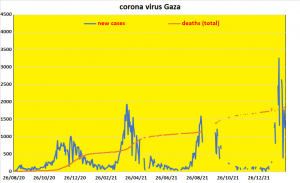
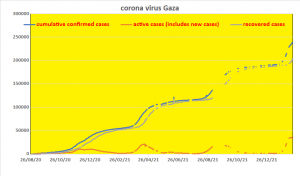
By late January the number of daily confirmed cases increased very significantly, and by February 5, a slight increase in deaths was registered (29 in the last week compared to 8 in the previous and 12 in the one before that.

The detection of omicron variant in Gaza was confirmed.At the end of January the Ministry of Health in Gaza denounced the scarcity of medical supplies that escalated the health crisis in all sectors, including assistance to Covid patients, due to the blockade.


Source: Ministry of Health, Gaza

Posted in Covid-19, Uncategorized | Comments Off on GAZA CORONAVIRUS UP TO 05-2-2022

Gaza, the Betrayed

Gaza is less than 100 kilometres from Jerusalem. It is deliberately placed out of reach, separated by three visible borders. The Israeli border is the main obstacle, but there are two others, each affirming the authority of one of the two conflicting Palestinian factions: Ramallah’s Palestinian Authority and Gaza’s own government. Less visibly, we are prevented from reaching Gaza by means of a diplomatic siege that has created institutional prohibitions. But even when official governmental permission to cross into Gaza is granted, we are often obligated to think of the institutional consequences.

Recently, after three attempts to enter Gaza on a medical mission, I managed to obtain all the right papers and to circumvent the institutional veto. I was contracted as a consultant by Medicins Du Monde (MDM) Spain to train and supervise psychologists working for the Ministry of Health and the Ministry of Education on the management of trauma-related conditions among children.

At the Erez checkpoint, the transition between the last Israeli neighbourhood in Ashkelon and the first Gazan neighbourhood of Beit Hanoun felt like a journey going back several decades in time. On the Israeli side, you see modern buildings, fancy cars and wide, modernised streets, while as you enter Gaza you are confronted with deteriorated infrastructure, broken roadways, carts drawn by animals, overcrowded living spaces, a multitude of children playing in the streets, dense lines of laundry hanging from the buildings, and fatigued faces regarding you with mysterious looks, perhaps wondering, “Why would anyone come to Gaza?”

To my surprise, there was no visible rubble of demolished homes remaining from the latest war on Gaza in May. I understood that any useful material is very quickly collected to be repurposed for future reconstruction. I noticed several amputee youth in the streets — young men and adolescents who lost a limb either during the war or because their knees were specifically targeted as they demonstrated in the Great March of Return. The graffiti displayed in the camps, in the city, and on the beach express support by the public of Gaza for Jerusalemites, for the people of Sheikh Jarrah, and for all Palestinian prisoners. Gaza, the captive, expresses resistance in order to liberate us!

War shines a spotlight on the misery of Gaza, but very quickly, this misery falls back into oblivion. Today, as I sit in the warmth of home to write this article — benefitting from a day off work because of the snowstorm affecting the region — I learn of a baby in Khan Yunis who died from Gaza’s lack of heating. Poverty, anaemia, food insecurity, lack of medical equipment, lack of fuel supply and lack of electricity are permanent in Gaza. I was deeply saddened when one of our trainees in Gaza, a senior colleague, mentioned in an informal gathering, “I visited Jerusalem last year.” The colleagues in Gaza expressed curiosity and even envy — to explain, she added: “I am a cancer patient and I was granted permission to be treated at the Augusta Victoria Hospital.” To have access to medical services outside Gaza one needs to be both very sick and very lucky at the same time.

Each of the clinical cases presented by the therapists were suffering from misery — in addition, in some instances, to psychopathology. Four out of 21 child cases were brought to supervision following the suicide of a family member. All of the others followed the traumatic death of a family member killed by the Israelis.  In one case, the child was the only survivor of her family. In another case, the child’s 17-year-old brother committed suicide after his mother pressured him to leave the home to obtain food; a sister reported to the school counselor that her mother was depressed and spent all of her time in bed. When a therapist reached out to the mother to offer support and an antidepressant, the mother responded: “I need food, not medication.”

There is no safe place in Gaza. The face of trauma intrudes when a home is demolished, when a classmate is killed, when a cousin takes an illegal boat and disappears forever, when there is a threat of another war, and when Israel attacks the fishermen and the farmers to deter them from struggling to earn a living. The threats are many and real.

I left Gaza very early on a Sunday morning to catch up with my work in the West Bank. I encountered the endless line of Palestinian laborers waiting to cross the Erez checkpoint to work. I was told that they had been waiting since 4am. In their lean bodies, dark wrinkled faces, cheap cigarettes and the plastic bags they carried with a change of underwear, I saw a tableau of modern slavery.  Unlike them, I was unaware that the Israelis would not allow me to cross the checkpoint with my suitcase.  I had to rush to empty its contents into plastic bags and throw away my suitcase before reaching the soldiers.

I went to Gaza to teach and supervise — but I learned a lot as a clinician, as a Palestinian compatriot and as a human being. If Gaza were one person, her deepest trauma would not be the enemy’s aggression but the betrayal by her neighbours, her brothers and her sisters. We have yet to find a national remedy for this betrayal.

Dr Samah Jabr

January 28, 2022

The views expressed in this article belong to the author and do not necessarily reflect the editorial policy of Middle East Monitor

Posted in March of Return, Uncategorized, War | Comments Off on Gaza, the Betrayed